Crypto / YMYL
How I Grew a Crypto Trading Platform's Organic Traffic by 127% Through a Bear Market
+127% organic traffic · 14,000 monthly visits on commercial pages · Survived 3 Google core updates
The Challenge
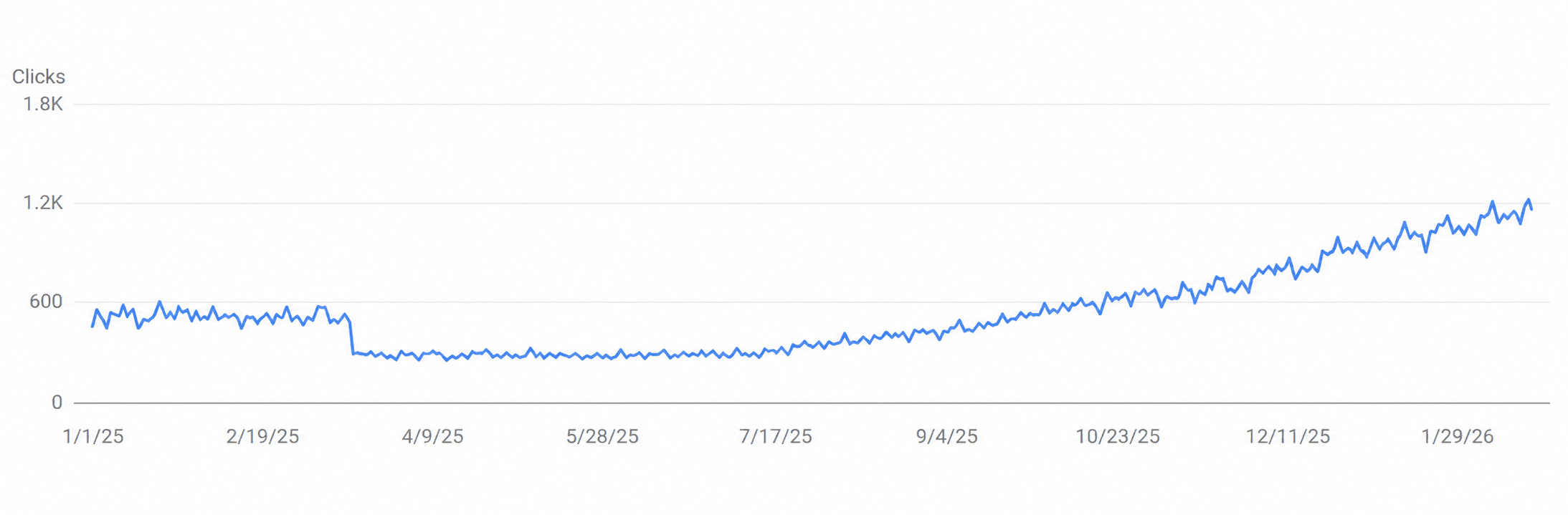
A mid-tier crypto trading platform came to me in rough shape. They were competing against top five exchanges with bigger budgets. Also, they had just been hit by the March 2024 core update. As a result, organic traffic dropped 35% overnight.
That core update is what brought them in. Before the drop, the business had been stable. However, once Google tightened the screws on YMYL content, everything changed. Because crypto sits at the peak of YMYL risk, Google got ruthless. Therefore, "how to buy" and "is X legit" queries became a trust battleground.
Also, the old SEO approach was volume-based. Four posts a week. Freelance writers. No author attribution. In other words, no expertise signal anywhere. So when the update hit, there was nothing to protect the rankings.
What I Found in the Audit
Five findings shaped the strategy.
First, 280 blog posts ran under a generic "CryptoTeam" byline. After the update, 80% had lost at least half their traffic. Because Google needed to know who was making financial claims, the anonymous content was dead weight. Furthermore, each post was dragging the site's trust signal lower.
Next, no expertise signals existed anywhere on the site. Meanwhile, competitors had named analysts with LinkedIn profiles, published research, and active Twitter accounts. Therefore, the E-E-A-T gap was not subtle. In fact, it was obvious on every page.
Also, "how to buy [coin]" guides were thin and templated. Same structure. Different coin. No insight. So Google had no reason to rank one over another. However, competitors had shipped original walk-throughs with real screenshots and fee data.
Then, risk disclosures were scattered. Some pages had compliance blocks. Others did not. As a result, trust signals were inconsistent. Furthermore, in YMYL, inconsistency reads as unreliability.
Finally, featured snippet opportunities were slipping. More than 120 "what is [term]" queries were feeding competitors. Because the site had the content to capture them, the issue was structural. Therefore, headers, answer formatting, and schema all needed work.
The Strategy
The thesis was clear. First, rebuild trust through real named expertise. Then, prune and rewrite the content that had lost traffic. Finally, fix the structural gaps that were handing featured snippets to competitors. Furthermore, do all of it in the right order.
Technical SEO
First, I tackled indexation bloat. The site had thousands of low-value URLs in the index. Filter combinations. Tag archives. Author pagination. So I noindexed the junk and cleaned up the crawl pattern.
Next, I rebuilt internal linking around commercial landing pages. Before, link equity had been flowing into blog archives and dying there. Therefore, I routed it into "how to buy" pages and core exchange features instead.
Also, I rolled out Article and FAQ schema across the top 50 pages. Then I added author schema tied to verifiable external profiles. So Google could connect the named authors on the site to their real-world credentials.
E-E-A-T and Named Expertise
This was the core of the rebuild. First, I brought on six named authors with real credentials. Two were CFA charterholders. Also, one was a former compliance officer at a regulated exchange. Then one was a blockchain developer with an active GitHub. Finally, two were published writers in crypto finance.
Next, each author got a full bio page with LinkedIn links and published work. Also, every financial article carried a disclosure block near the call to action. In addition, the block named the author, their credentials, and the date of the last review.
Therefore, when Google crawled the site, it could connect claims to real people with verifiable expertise. That is the bar for YMYL in 2024. Because trust is now the ranking factor, there is no shortcut.
On-Page Rebuild
Then came the "how to buy" rewrite. First, I targeted the top 30 coin guides. Also, each one got an original step-by-step flow using the client's actual product. Real screenshots. Real fees. Real risk disclosures. So the content stopped being templated. Instead, it showed the buyer exactly what the process looked like.
Also, each guide included a fee comparison against the top three competitors. Because buyers making their first crypto purchase care about cost, that data answered a real question. Furthermore, the pages linked directly to the client's sign-up flow with proper tracking.
Content Pruning and Rebuild
Next, I pruned 180 low-value posts. First, some were consolidated into comprehensive resources. Also, others were deleted and 301'd to relevant category pages. Then 40 posts were fully rewritten under the new named authors with updated data.
After that, the remaining content was grouped into four topic clusters. Buying. Trading. Security. Specific asset guides. Also, each cluster had a pillar page and supporting articles. Therefore, internal linking flowed naturally between them.
The Results
After 14 months, the numbers were clear.
First, organic traffic grew by 127% over the full engagement. That includes the recovery from the March 2024 core update losses. Next, the top 30 commercial pages grew from roughly 4,200 monthly visits to 14,000. Also, the site ranked for 40 "how to buy [coin]" head terms where it previously ranked for none.
Moreover, the site survived three Google core updates during the engagement. The last two were net-positive. In other words, the E-E-A-T rebuild was not just a recovery play. Furthermore, it turned Google's update cycle from a threat into a tailwind.
Also, featured snippet capture rose sharply. Then the site reclaimed 38 snippets that had been held by competitors. Because many of those were "what is [term]" queries, the traffic was stable and recurring.
What This Means for You
If you are in crypto or any YMYL space, the lesson here is clear. First, Google will not rank anonymous content on financial topics anymore. Next, if you cannot point to a real human with real credentials behind a claim, you are not going to rank. Furthermore, this is true for health, legal, and financial content across the board.
Also, pruning is not a loss. Instead, it is a recovery tool. In fact, most YMYL sites are carrying hundreds of posts that are actively hurting them. Therefore, the fix is to cut deep, rebuild the core pages under named experts, and then trust the process.