iGaming
How I Took a UK Online Casino From 14K to 180K Monthly Organic Clicks in 10 Months
+1,185% organic clicks · 1,000+ keywords on page 1 · 900% ROI
The Challenge
A UKGC-licensed online casino came to me. They were stuck at around 14,000 monthly organic clicks. In fact, they had sat at that level for over six months. The product was decent. The brand was known. However, organic traffic had gone flat.
So the previous agency had published content for months. Posts kept getting indexed. Still, almost nothing was ranking. That is the classic "publish and pray" pattern. As a result, it burns retainer without moving revenue.
Also, UK iGaming is one of the toughest YMYL spaces online. Google treats it with care. Therefore, without strong E-E-A-T signals, nothing else compounds. That was the deeper issue. Additionally, it sat underneath a technical problem nobody had flagged.
What I Found in the Audit
First, I ran a full technical and content audit. Then five findings shaped the whole plan.
The site was JavaScript-heavy with no server-side rendering. Furthermore, this was the real blocker. The framework was injecting category content client-side. For example, game lists, filters, and even the H1 were missing from the initial HTML response. Once I compared the raw response with the rendered version, critical content was missing. So that explained why new category pages like live baccarat or online roulette had never ranked. As a result, Google was crawling near-empty shells. Therefore, no content strategy could save the site.
Next, author entities did not exist. Every review and guide went out under a generic "Editorial Team" byline. In UK iGaming, however, that is a trust disaster. Also, Google needs to know who makes claims about money and odds.
Third, responsible gambling signals were buried. Although the footer had standard links, none of the money pages carried contextual trust blocks. So a player reading a casino review had no visible reminder of safer gambling resources.
Then, category pages were thin. The top commercial pages had roughly 200 words of intro. Meanwhile, competitors were running 2,500-word pillar pages with comparison tables and FAQ sections.
Finally, the backlink profile was unusually clean. Anchor distribution was wide and natural. Because brand, naked URL, generic, and topical anchors sat in a healthy ratio, the site had room to grow. So that finding changed the plan. As a result, I could run a more commercial link campaign than usual for a YMYL client.
The Strategy
The thesis was simple. First, fix the rendering. Then, rebuild trust signals. Finally, add link pressure once the profile could absorb it.
Technical SEO and the Turning Point
So priority one was server-side rendering. For three weeks, I worked with the dev team to ship SSR on all category, provider, and game-detail templates. After the deploy, Google started receiving fully rendered HTML on the first response.
The impact was quick. Within three weeks, existing category pages began moving up. Then, more importantly, I could finally launch the blocked category hubs. Live baccarat, online roulette, provider pages, and payment method pages went live. Also, they actually ranked. Therefore, that was the inflection point of the whole engagement.
Alongside SSR, I fixed LCP by removing an unoptimized hero carousel. Next, I cleaned up 1,200 duplicate URLs from faceted filters. Then I rolled out Review, FAQ, and Organization schema across the money pages.
E-E-A-T and Trust Signals
I rebuilt the author system. Now every review and guide runs under a named author with a real bio. Credentials include UKGC experience and industry years. Each author page links to verifiable external profiles.
Also, I added responsible gambling context blocks on every money page. However, these were not footer afterthoughts. Instead, they sat near the call to action with direct links to GamCare and UKGC resources. This matters for two reasons. First, it helps compliance. Second, Google reads the same trust cues.
On-Page Rebuild
Once SSR was in place, I rebuilt the top 40 commercial pages around a consistent template. Each page now has a TL;DR box, a comparison table, pros and cons, operator details, an FAQ, and the responsible gambling block.
Then, after the foundation held, I launched 20 new category and provider hubs. Pages that had been blocked for years started ranking within four to six weeks.
Content and Topical Authority
Next, I mapped the niche into 14 topic clusters. Slots, live casino, payment methods, and game providers each got a pillar page with supporting articles. Also, internal linking was deliberate. Every supporting piece pointed into the relevant commercial hub with matched anchors.
Link Building and Digital PR
Because the existing anchor profile was wide and natural, I ran a harder campaign than usual. Focus went on three channels. First, digital PR placements on UK finance and lifestyle publications. Second, sponsored data studies picked up by gambling trade media. Third, reclaiming 40 unlinked brand mentions already sitting on real publisher sites.
However, pace stayed steady. No velocity spikes. Also, anchor mix kept its variety. Commercial anchors pointed at money pages only after the technical and trust work was in place.
The Results
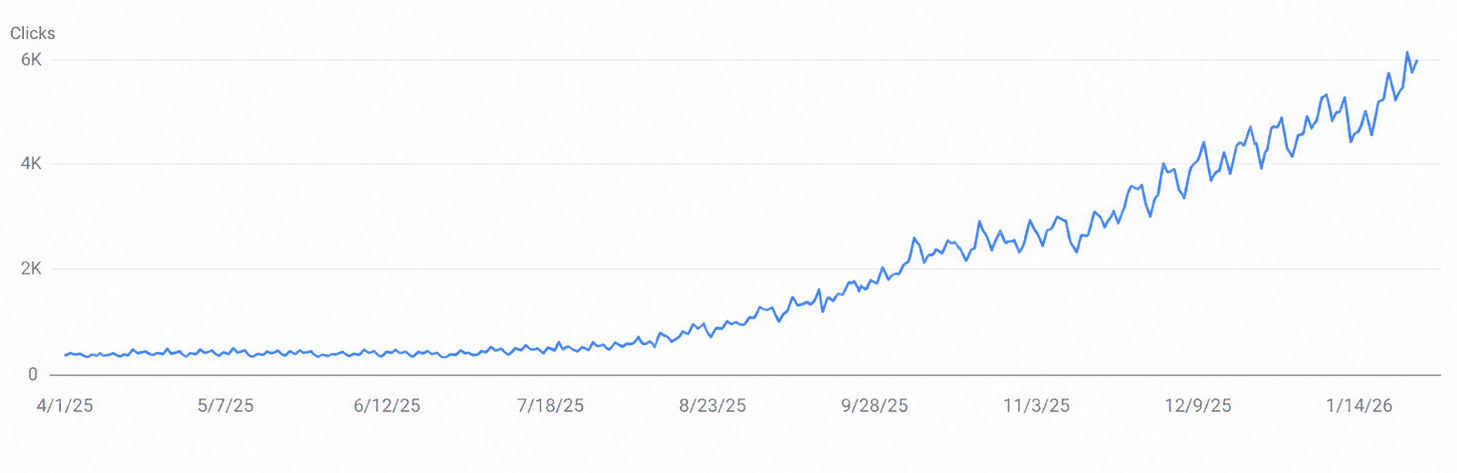
After 10 months, the numbers looked like this.
First, organic clicks went from 14,000 to 180,000 per month. Therefore, that is a 1,185% lift. Then page 1 rankings grew from around 90 to over 1,000 keywords. Also, the site now holds 62 page 1 rankings for commercial "best [X] casino UK" terms. Several of them are head terms in the live casino and slots verticals.
Based on client-reported first-time deposit revenue, the engagement delivered roughly 900% ROI. Moreover, new categories that had been impossible to launch for two years now drive five-figure monthly clicks on their own.
What This Means for You
If your iGaming content is not ranking, the fix might not be more content. Instead, it might be rendering. Because half the sites I audit in this space have some version of this problem, the fastest path forward is usually the same. First, fix the foundation. Then, earn trust. Finally, apply link pressure in the right order.